Winning in 2026 requires a shift from “ranking for keywords” to “becoming a trusted source for AI.” Traditional search engines still matter, but AI models (like Gemini and GPT) prioritize content that is extractable, verifiable, and structured.
Here are the key metrics and attributes that define a high-performing website today.
1. AI-Specific Metrics (GEO/AEO)
Since AI often provides answers without a user clicking through, you must track your visibility inside the AI response.
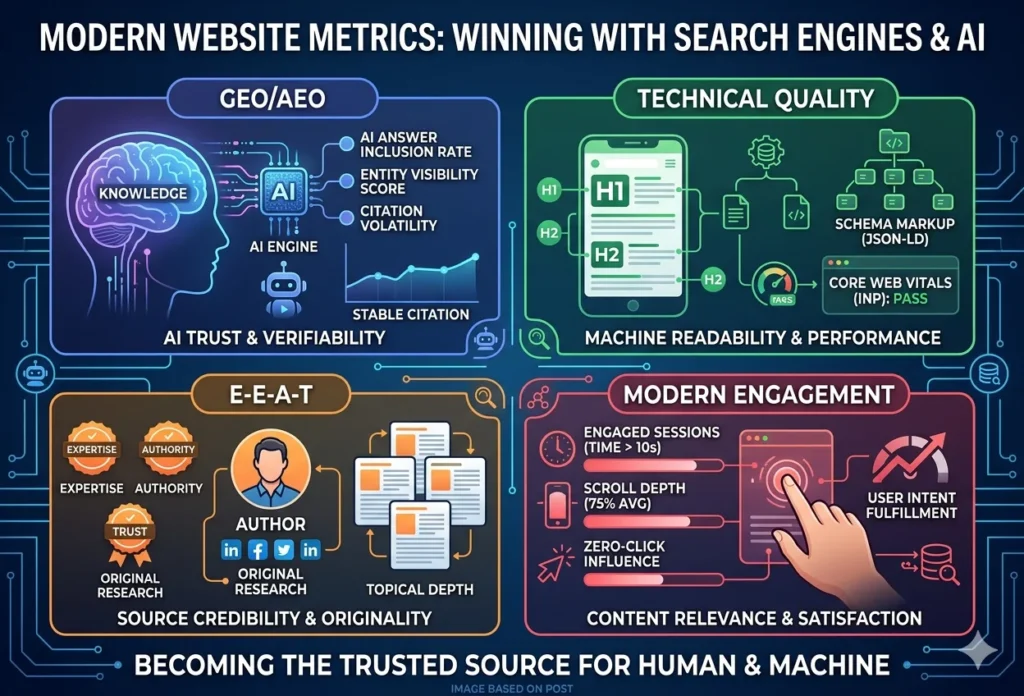
- AI Answer Inclusion Rate: The percentage of times your brand or content is cited in AI-generated answers for your top priority prompts.
- Entity Visibility Score: How well AI “understands” your website as a specific brand or expert entity. If AI doesn’t recognize your brand as an authority on a topic, it won’t recommend you.
- Citation Volatility: How often your brand is replaced by a competitor in AI summaries. High volatility usually means your content lacks the unique “data depth” needed to stay as the primary source.
2. Technical Quality & Machine Readability
AI and search engines both look for “clean” sites that are easy to crawl and parse.
- Structural Clarity: Using a logical hierarchy (H1 > H2 > H3) with concise, answer-first paragraphs (around 120–150 words) near the top of the page.
- Schema Markup (JSON-LD): Extensive use of structured data (Organization, FAQ, Review, Event, and Author schemas). This makes your data “machine-readable.”
llms.txtFiles: A new standard in 2026 used to provide explicit instructions and summaries directly to AI crawlers, helping them understand your site’s most important pages.- Core Web Vitals: Specifically INP (Interaction to Next Paint), which replaced older responsiveness metrics to measure how fast a user can actually interact with your site.
3. Authority & Trust (E-E-A-T)
Trust is the most significant factor for AI. If the information is even slightly “hallucinated” or incorrect, AI will stop citing you.
- Topical Authority Depth: Covering a niche so thoroughly that you have a “cluster” of 20+ related articles, rather than just one-off posts.
- Verified Expertise: Clear author bios, links to professional LinkedIn profiles, and citations of original research or first-hand experience.
- Branded Search Volume: A rise in people searching for your site by name is a major signal to AI that you are a trusted entity in your field.
4. Modern Engagement Metrics
Standard “Total Traffic” is becoming a vanity metric. Focus on these instead:
- Engaged Sessions: A session that lasts longer than 10 seconds, has a conversion event, or involves at least two page views.
- Scroll Depth & Dwell Time: High dwell time signals to AI that your content successfully answered the user’s intent.
- Zero-Click Influence: Even if users don’t click, being cited in an AI overview builds brand memory, which leads to direct traffic later.
What AI look for when auditing a website:
- Directness: Does the page answer the main question in the first two paragraphs?
- Unique Data: Does the site provide original facts, tables, or insights that can’t be found on 10 other sites? (AI loves unique data sets).
- Bot Management: Is the server healthy enough to handle both search engine crawlers and high-frequency AI scrapers without slowing down?
- Schema Accuracy: Is the structured data perfectly aligned with what is actually visible on the page?
To win in both Search Engines (Google) and AI systems (ChatGPT, Perplexity, Gemini, etc.), a website must go far beyond traditional SEO. The above process will definitely help you optimize your website and improve rankings faster.