In 2026, content is no longer just about writing articles—it’s about understanding why the content exists and how it transfers value.
Many marketers try to copy high-authority platforms like The Conversation or university blogs. But what they miss is simple:
Not all content is created for the same purpose.
This is where two critical concepts come in:
- Conversation Content
- Authority Bridge Content
Understanding this difference can completely change your SEO results.
What is Conversation Content?
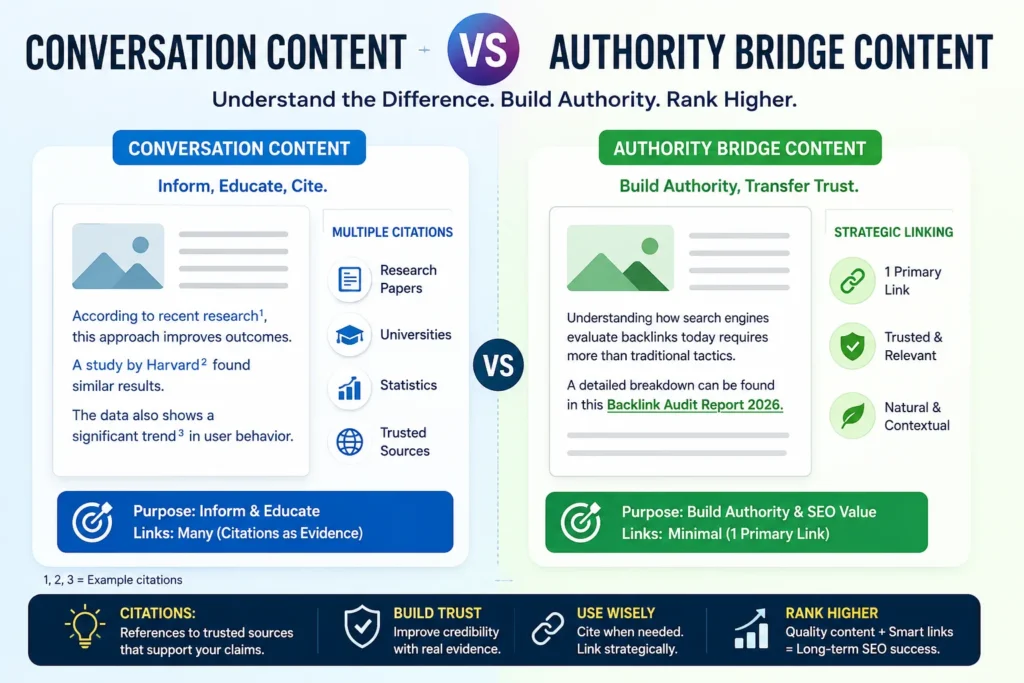
Conversation Content is a type of editorial content created to inform, educate, and contribute to public understanding—rather than to rank in search engines or promote a specific website. It is rooted in research, expert insight, and real-world knowledge, making it highly valuable in the era of AI-driven information consumption.
This format is commonly used by academic and research-focused platforms such as university blogs, public knowledge portals, and independent research publications. The goal is not to capture traffic through SEO tactics, but to build trust, authority, and intellectual credibility.
Unlike commercial blog content, Conversation Content prioritizes clarity, accuracy, and neutrality. It answers real questions, explains complex topics in an accessible way, and supports every claim with verifiable sources.
Where It Is Commonly Used
- Academic and university blogs
- Research publications and journals
- Public knowledge platforms (e.g., policy, science, education portals)
Key Characteristics
- Focuses on education and public knowledge
- Backed by research, data, and expert opinion
- Includes multiple citations to support claims
- Maintains a neutral, non-promotional tone
- Does not attempt to push or rank a specific website
How Citations Work in Conversation Content
Citations are the backbone of this content type. They provide proof for claims, add credibility, and allow readers to verify information independently.
Instead of making unsupported statements, each important claim is followed by:
- A reference to a research paper, study, or dataset
- Expert commentary or institutional source
- Proper attribution (author, publication, year where applicable)
This creates transparency and positions the content as trustworthy and academically aligned.
Typical Structure
A well-written Conversation Content piece usually follows a logical, evidence-based flow:
- Claim – Introduce a clear idea or statement
- Supporting Research – Back the claim with data, studies, or statistics
- Expert Explanation – Add interpretation or insight from experts
- References (Citations) – List sources to validate the information
Simple Example Flow
- Claim: Remote work improves productivity in knowledge-based roles
- Supporting Research: Studies from global workforce reports
- Expert Explanation: Insights from organizational psychologists
- References: Linked research papers, institutional reports
What is Authority Bridge Content?
Authority Bridge Content is a strategic content format that connects high-trust, research-driven information with your website’s expertise, services, or solutions. Unlike pure editorial content, this type is designed to both build credibility and guide users toward meaningful action—without being overly promotional.
It acts as a “bridge” between informational content (like academic insights or industry research) and practical application (your services, tools, or recommendations). This is the type of content that performs strongly in modern SEO because it aligns with both user intent and search engine trust signals.
Instead of just informing, Authority Bridge Content interprets, simplifies, and connects information to real-world decisions.
Where It Is Commonly Used
- SEO-driven blogs and niche websites
- SaaS and service-based business websites
- Industry resource hubs and guides
- Affiliate and comparison content platforms
Key Characteristics
- Combines research with practical application
- Uses citations but adds interpretation and context
- Aligns with search intent (informational + transactional)
- Naturally introduces solutions, tools, or services
- Includes internal linking to relevant site content
- Maintains trust while guiding user decisions
How Citations Work in Authority Bridge Content
Citations are still important—but they serve a slightly different role compared to Conversation Content.
Instead of just validating information, citations here are used to:
- Support key claims and trends
- Strengthen topical authority
- Build trust before introducing a solution
After presenting credible data or insights, the content bridges into actionable guidance, often leading to:
- Recommendations
- Tools or services
- Internal resources
This creates a balance between trust (proof) and conversion (action).
Typical Structure
Authority Bridge Content follows a more conversion-aware structure while still maintaining credibility:
- Claim / Problem – Identify a real user problem or topic
- Supporting Research – Provide data, trends, or credible insights
- Interpretation – Explain what this means in a practical context
- Bridge (Transition) – Connect the insight to a solution or need
- Solution / Recommendation – Introduce tools, services, or guides
- Internal Links / CTA – Guide users to deeper resources on your site
Simple Example Flow
- Claim: Many websites lose rankings after core updates
- Supporting Research: SEO studies and algorithm update reports
- Interpretation: Most sites lack content depth and authority signals
- Bridge: This is where structured audits and strategy matter
- Solution: Recommend a backlink audit and SEO intelligence approach
- Internal Link
Why It Matters in 2026 SEO
With AI-generated answers reducing reliance on basic blog content, Authority Bridge Content plays a critical role:
- It differentiates your site from generic AI responses
- It demonstrates real expertise and applied knowledge
- It improves engagement, trust, and conversions
- It helps search engines understand your site as a solution provider, not just an information source
Conversation Content vs Authority Bridge Content
| Factor | Conversation Content | Authority Bridge Content |
|---|---|---|
| Purpose | Inform & educate | Transfer SEO authority |
| Links | Many citations | Minimal, strategic |
| Tone | Academic/editorial | Editorial + strategic |
| SEO intent | None | High |
| Risk | Low | High if over-optimized |
Why Most People Fail
Most SEO strategies don’t fail because of a lack of effort—they fail because of misaligned execution. Many creators still follow outdated practices that prioritize manipulation over value, which modern search systems can easily recognize.
A common mistake is treating SEO as a technical loophole rather than a content strategy. Instead of focusing on clarity, trust, and user intent, many try to “engineer” rankings through artificial signals.
This leads to patterns that are predictable—and therefore easy for search engines to detect and devalue.
Common Mistakes in SEO Execution
- ❌ Using excessive backlinks like citations
Adding multiple links without contextual relevance weakens credibility instead of strengthening it. - ❌ Over-optimizing anchor text
Repeating exact-match keywords creates unnatural linking patterns and signals manipulation. - ❌ Forcing internal links
Inserting links where they don’t naturally belong disrupts content flow and reduces user trust.
The Core Problem
These approaches create a synthetic content footprint—where the structure looks optimized for algorithms rather than helpful for users.
Modern search systems prioritize context, intent, and authenticity, not just link signals. When content feels engineered instead of natural, it loses both ranking potential and reader engagement.
The Correct Strategy (2026 SEO Reality)
The modern SEO approach is not about choosing between content quality and optimization—it’s about integrating both intelligently.
1. Use Conversation Style Writing
Focus on creating content that is:
- Clean and easy to understand
- Informative and genuinely helpful
- Backed by research and credible insights
This builds trust, improves readability, and aligns with how users (and AI systems) consume information today.
2. Apply Authority Bridge Linking
Instead of adding multiple or forced links, use a single, high-quality connection point:
- ✔ One primary link per context
- ✔ Placed naturally within the flow of content
- ✔ Introduced only when it adds real value
The goal is not to push links—but to guide users logically from information to action.
SEO in 2026 is no longer about how many signals you can add—it’s about how naturally those signals fit within valuable content.
When you combine conversation-driven writing with intentional, context-based linking, you create content that not only ranks—but also builds authority, trust, and long-term visibility.