Google is no longer ranking content — it is ranking credibility, originality, and real value.
SEO in 2026 is no longer about:
- Keywords
- Backlinks alone
It is about:
- Trust
- Experience
- Information Gain
- User satisfaction
Note: The March 2026 update caused massive ranking fluctuations across industries.
Key Observations:
- Nearly 80% of top 3 search results changed positions
- Over 90% of top 10 results experienced shifts
- Around 25% of top-ranking pages dropped out of the top 100
This level of volatility was significantly higher than previous updates, indicating a major recalibration of ranking signals.
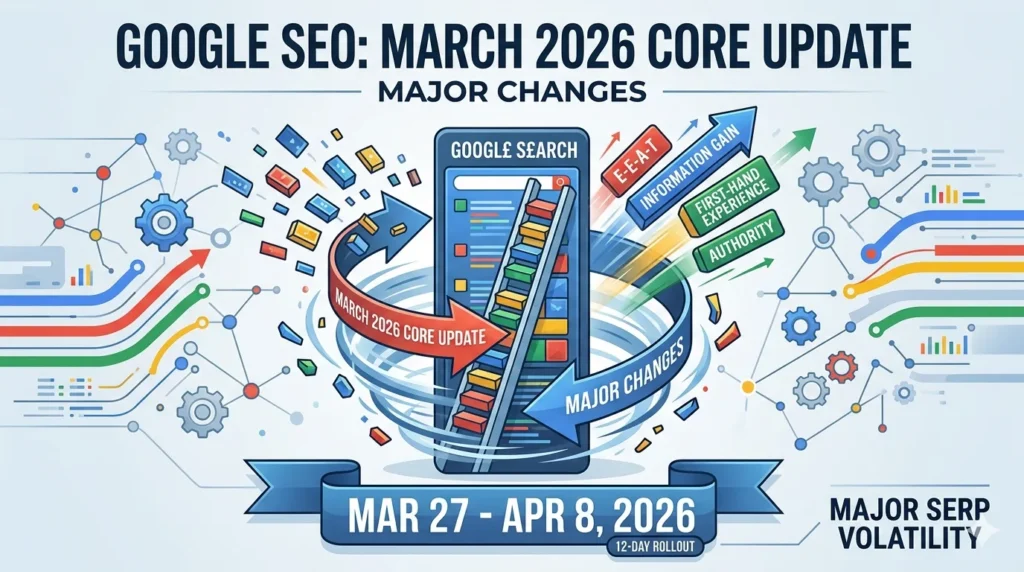
The search landscape experienced a massive shakeup as Google rolled out its first major broad core update of the year. Beginning on March 27, 2026, and concluding on April 8, 2026, the 12-day rollout triggered intense volatility across search engine results pages (SERPs). Data from early impact reports revealed that nearly 80% of top-three results shifted, making it one of the most disruptive updates in recent SEO history.
Unlike minor patches, this broad core update represents a structural recalibration of how Google defines quality, authority, and alignment. Coming immediately on the heels of the rapid March 24 Spam Update, the March Core Update signaled a clear operational shift: Google is aggressively filtering out data “slop” and programmatic scaling to clear a path for authentic, deeply human, and authoritative brands.
The Strategic Sequence: The March “One-Two Punch”
The March 2026 update environment was unique due to its sequencing. Google essentially “cleared the table” before executing its broader quality reassessment:
The March 24–25 Spam Update: Completed in a record-breaking 20 hours, this update directly attacked policy violations—specifically targeting mass-produced AI content manipulation, low-quality scaled content abuse, and manipulative link profiles.
The March 27 Broad Core Update: Once explicit spam was filtered out, Google deployed the core update to qualitatively evaluate the remaining ecosystem based on user satisfaction and structural trust.
If your site saw a sharp drop between March 24 and 26, it was likely flagged by the Spam Update’s automated classifiers. Drops occurring after March 27 point to systemic content quality issues under the core algorithm.
3 Major Structural Changes in the March 2026 Update
1. From Keyword Matching to True “Information Gain”
The threshold for content viability has risen significantly. Google’s upgraded AI-based classifiers are no longer just looking for comprehensive answers; they are filtering out “surface-level aggregation.”
If an article simply synthesizes or rehashes the top 5 results already existing on the web, it fails the Information Gain test. The update aggressively demoted thin content hubs and generic roundups that failed to offer unique perspectives, proprietary data, or new insights.
2. E-E-A-T and The “First-Hand Experience” Dominance
While Experience, Expertise, Authoritativeness, and Trustworthiness (E-E-A-T) have been core to Google’s philosophy for years, the March 2026 update turned these guidelines into strict ranking enforcement mechanisms.
- Lived Experience Over Rehashed AI: Content backed by documented, first-hand implementation, case studies, or original multi-media evidence saw massive ranking surges.
- Author Profiles and Transparency: Google heavily penalized anonymous or loosely attributed content. Clear author credentials, verifiable bios, and domain-level transparency are no longer optional “nice-to-haves.”
3. Domain-Wide Re-evaluation of Topical Authority
The algorithm has evolved past assessing content solely on a page-by-page basis. In this update, Google clamped down on “reputation exploitation” and fragmented content strategies.
- The Winner: Niche-focused, hyper-specific sites that possess clear topical authority across their entire domain.
- The Loser: Large content hubs or broad publication sites that cover highly disconnected topics without true depth, attempting to ride on legacy Domain Authority to rank for trending keywords.
Winners vs. Losers: The SERP Shift
Initial post-rollout volatility metrics paint a clear picture of who won and who lost ground during the late-March shakeup:
| Winners (Surged Visibility) | Losers (Dropped Visibility) |
| Data-Rich Sources & Official Brands: Sites containing proprietary statistics, primary source data, and verified brand entities. | Shallow Aggregators: Thin affiliate comparison sites, programmatic SEO directories with low unique value, and mass digital roundups. |
| Hyper-Niche Subject Matter Experts: Publishers focused deeply on single verticals with strong topic clusters. | Broad Content Hubs: Websites treating unrelated verticals superficially just to capture search volume. |
| Technically Optimized Engines: Sites boasting load times under 2 seconds and pristine UX/mobile responsiveness. | YouTube & Traditional Video Links: Interestingly, dataset analyses noted a brief downward visibility shift for traditional video elements in core web search results. |
The Broader Horizon: Unified SEO for Search and GenAI
A critical takeaway from the March 2026 Core Update is that Google’s core ranking systems are converging with its AI initiatives. The signals Google now uses to determine standard organic rankings are identical to those feeding Google AI Overviews.
Furthermore, optimizing for these high-signal quality factors simultaneously secures brand visibility in alternative GenAI ecosystems like ChatGPT Search and Perplexity. There are no longer separate strategies for traditional SEO and Generative Engine Optimization (GEO); creating original, highly authoritative content is the unified path forward.
Action Plan: Post-Update Audit and Recovery
If your organic traffic or impression share dropped significantly during or after the March update, do not frantically delete or rewrite your site overnight. Follow this structured approach to recovery:
Phase 1: Wait and Benchmark
Allow at least one to two weeks following the April 8 completion date for search patterns to stabilize. Compare a clean 14-day baseline period from before March 27 against your performance after April 8 using Google Search Console.
Phase 2: Run an Intent-Alignment Audit
Isolate the specific landing pages that suffered the sharpest declines in impressions and clicks. Analyze the pages that replaced you in the top three slots:
- Are they offering a different format (e.g., changing from an informational blog post to a transactional calculator tool)?
- Do they present unique data or primary quotes that your page lacks?
Phase 3: Implement Content Remediation
Instead of expanding word count with generic fluff, focus heavily on upgrading your page’s trust architecture:
- Inject original imagery, case studies, or specialized insights to boost the “Experience” vector of E-E-A-T.
- Tighten up site-wide technical health; optimize core web vitals, as data confirms that slower loading sites (over 2 seconds) took a disproportionate hit during this update.
- Consolidate or prune thin, outdated, or disconnected pages on your domain to strengthen your core topical authority footprint.