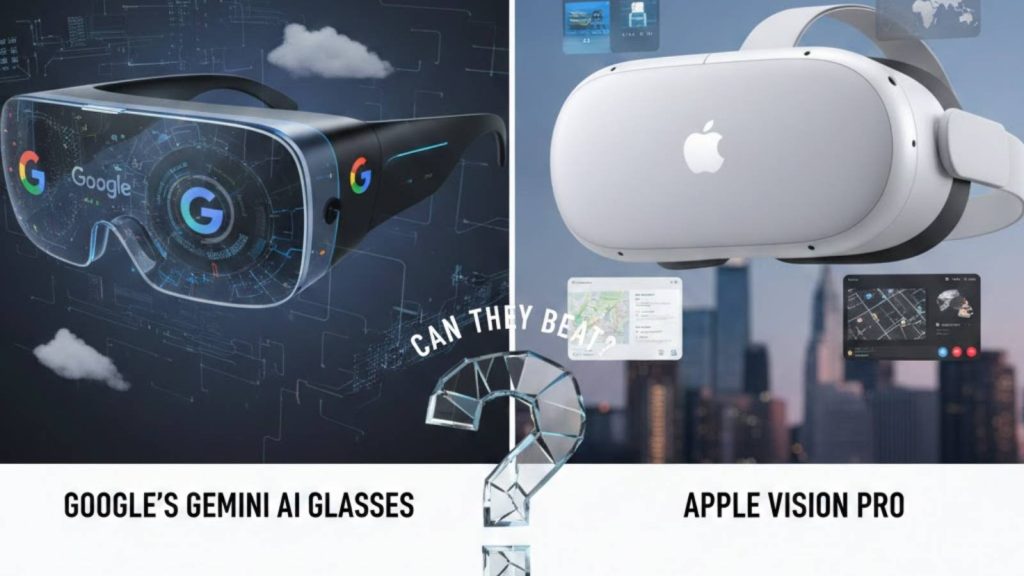
Race toward the future of wearable technology is heating up faster than ever, and 2026 is shaping up to be a defining year. With Google preparing the launch of Google’s Gemini AI Glasses, and Apple gearing up for the next generation of its already iconic Vision Pro series, consumers and tech analysts are eager to see which giant will dominate the next phase of AR and AI-powered wearables.
The market for smart glasses and mixed-reality headsets has matured significantly, and users expect far more than just holographic displays. They want seamless real-world integration, advanced AI assistance, smoother mixed-reality experiences, and practical everyday applications. With Google leveraging Gemini—one of the world’s most advanced multimodal AI models—and Apple pushing forward with Vision Pro enhancements and deeper Apple Intelligence integration, the competition has turned into a showdown of innovation, practicality, and futuristic design.
Find every detail to answer the burning question: Can Google’s Gemini AI Glasses really outperform the Apple Vision Pro in 2026?
What Are Google’s Gemini AI Glasses? Expected Features, Specs & Launch Updates
Google has been developing smart glasses for years—starting with the early Google Glass experiment and later shifting to enterprise wearables. Google’s Gemini AI Glasses represent a new era. These glasses are expected to combine advanced AR capabilities with Google’s most powerful AI system, Gemini, which excels at multimodal reasoning, real-time translation, generative assistance, and contextual understanding.
Expected Features
- Real-time multilingual translation directly in your field of view
- Live object identification for shopping, travel, education, and accessibility
- Hands-free AI assistant powered by Gemini Ultra
- AR overlays for navigation, productivity, and entertainment
- Lightweight design targeted for daily use rather than just VR immersion
- High-efficiency micro-display lenses for sharp visual output
- Gesture-based and voice-based controls
Launch & Price Expectations
Reports suggest that Google aims for a 2026 mid-year launch, possibly priced between $1,200 and $1,800, making it significantly more affordable than Apple Vision Pro. The strategy is clear: Google wants smart glasses for everyday users, not just tech enthusiasts.
Executed well, Google’s Gemini AI Glasses could become the most user-friendly AI wearable on the market.
Apple Vision Pro 2026 Edition: What’s New & Why Apple Fans Are Excited
Apple has already proven its dominance with the Vision Pro, a luxury-grade mixed-reality headset designed to merge digital and physical spaces. The 2026 edition is expected to be lighter, faster, and far more powerful, addressing critiques of weight, battery life, and app ecosystem.
Key Expected Upgrades
- Slimmer design for improved comfort
- Upgraded micro-OLED displays with higher brightness and clarity
- Apple Intelligence deep integration for smarter multitasking
- Better gestures and eye-tracking system
- Improved spatial audio and sensors
- Lower price point compared to the first generation
Apple’s strength lies in its ecosystem. Once the Vision Pro connects with iPhone, Mac, iPad, and Apple Intelligence, the experience becomes smooth and unmatched. The 2026 Vision Pro aims to refine this ecosystem integration even further.
Full Specs Comparison: Google’s Gemini AI Glasses vs Apple Vision Pro (2026)
Here’s a detailed breakdown based on leaks, patents, and industry analysis:
| Feature | Google’s Gemini AI Glasses | Apple Vision Pro 2026 |
|---|---|---|
| Type | Everyday smart AI glasses | High-end mixed-reality headset |
| Display | Micro-display lenses, focus on AR | Dual micro-OLED VR/AR displays |
| AI System | Google Gemini Ultra | Apple Intelligence + visionOS |
| Design | Slim, lightweight frame | Headset with straps and external battery |
| Sensors | Basic AR sensors, eye-tracking | Advanced 3D mapping, LiDAR, 12+ cameras |
| Battery | 6–10 hours expected | 2–3 hours per battery pack |
| Price Range | $1200–$1800 expected | $2500–$3000 expected |
While Vision Pro excels in immersive, high-end experiences, Google’s Gemini AI Glasses aim for practicality, accessibility, and seamless everyday usage.
AI Performance Showdown: Can Gemini Outthink visionOS and Apple Intelligence?
AI is the heart of this competition. The question isn’t just about displays or sensors—it’s about which device can think faster, understand better, and assist the user more accurately.
Google Gemini AI Advantages
- Multimodal reasoning (video, voice, image, text)
- Real-time contextual understanding
- Accurate translation and transcription
- Strong knowledge graph integration
- Superior conversational intelligence
Apple Intelligence Advantages
- Personalized device-syncing and user data processing
- Strong privacy-focused local AI processing
- Deep integration with iPhone, iPad, and Mac
- Extremely reliable performance
Design & Comfort: Which Device Feels Better for Daily Use?
Design may be the biggest deciding factor for many buyers.
Google’s Gemini AI Glasses Design
Google is focusing on making smart glasses that look like normal glasses. Early renders suggest:
- Lightweight frames
- Sleek temples with hidden sensors
- Multiple frame styles
- Comfortable nose pads
- Suitable for outdoor wear
These glasses appear to target comfort first, making them wearable for full-day use.
Apple Vision Pro 2026 Design
While expected to be lighter than the 2024 version, Vision Pro remains:
- Bulky due to large displays
- Heavy on the face for long usage
- Better for indoor environments
- More suited for professional or entertainment purposes
For everyday comfort, Google’s Gemini AI Glasses clearly have the advantage.
AR, VR & Mixed-Reality Features: Who Leads in Immersive Experiences?
Apple Vision Pro excels in full VR and advanced AR, while Google’s Gemini AI Glasses focus on practical, everyday AR overlays.
Apple Vision Pro 2026
Vision Pro is a full mixed-reality beast:
- Full VR immersion
- 3D mapping and spatial environments
- High-end AR overlays
- Best-in-class cameras and sensors
Google’s Gemini AI Glasses
These glasses are focused on light AR, such as:
- Navigation arrows
- Real-time text overlays
- Object labels
- AI-generated recommendations in your field of view
Battery Life & Performance: Which Wearable Lasts Longer?
Battery life remains one of the biggest concerns in wearables.
Google’s Gemini AI Glasses
Expected battery life is 6 to 10 hours, depending on usage. These glasses benefit from low-power components and cloud-based AI processing.
Apple Vision Pro 2026
Vision Pro still relies on external battery packs, offering:
- Around 2 to 3 hours per battery
- Additional packs required for longer use
Price Comparison: Which Device Offers the Best Value in 2026?
Price will play a massive role in determining the winner.
Expected Prices
- Google’s Gemini AI Glasses: $1200–$1800
- Apple Vision Pro 2026: $2500–$3000
Google offers a more affordable, accessible wearable for the everyday user. Apple targets professionals, designers, developers, and premium buyers.
FAQs
1. Will Google’s Gemini AI Glasses support Android and iOS devices?
Google’s Gemini AI Glasses are expected to natively support Android devices, particularly Pixel phones, for seamless integration with Google services. While full iOS support may be limited, users can still access basic features through companion apps, but Apple’s ecosystem is optimized primarily for Vision Pro users, giving Apple an edge for iPhone and iPad integration.
2. Can Google’s Gemini AI Glasses run third-party apps?
Yes, Google is likely to open the Gemini platform to third-party developers, allowing apps for navigation, productivity, translation, education, and AR-based shopping. This flexibility may give the glasses a wider range of practical applications compared to Apple Vision Pro, which relies on the curated visionOS app ecosystem.
3. How secure are Google’s Gemini AI Glasses compared to Apple Vision Pro?
Security is a key differentiator. Google’s Gemini AI Glasses will rely on cloud-based AI processing, which may require robust encryption to protect user data. Apple Vision Pro, on the other hand, emphasizes local processing and privacy, ensuring that sensitive data like eye-tracking and spatial mapping remain on-device. Users who prioritize privacy may prefer Apple, while those prioritizing AI features may choose Google.
4. Will Google’s Gemini AI Glasses support gaming?
Gaming support on Google’s Gemini AI Glasses is expected to be limited to casual AR games and productivity-oriented experiences. Unlike Apple Vision Pro, which can provide immersive VR and high-fidelity AR gaming, Google’s glasses are optimized for lightweight AR overlays rather than intensive graphics processing.
5. How will Google’s Gemini AI Glasses perform outdoors in bright sunlight?
Google is expected to incorporate high-efficiency micro-display lenses with anti-reflective coatings to improve visibility outdoors. While sunlight may still reduce clarity compared to indoor use, the glasses are designed for mobility and daily wear, whereas Apple Vision Pro, being a full headset, is better suited for indoor or controlled lighting environments.
6. Are Google’s Gemini AI Glasses suitable for professional work?
While not designed as a high-end mixed-reality workstation like Vision Pro, Google’s Gemini AI Glasses can assist in professional tasks such as real-time translation, hands-free note-taking, navigation for fieldwork, or AR-based educational training. Apple Vision Pro remains better for intensive professional use such as 3D design, spatial computing, and immersive collaboration.
7. Will Google’s Gemini AI Glasses support voice assistants?
Absolutely. Google’s glasses will integrate with Google Assistant and Gemini AI, allowing users to interact via voice commands for tasks like reminders, calls, translations, and contextual information. This hands-free operation is a key advantage for mobility and convenience, whereas Vision Pro uses a combination of Siri, gestures, and eye-tracking.
8. What materials are used in Google’s Gemini AI Glasses for durability?
Google is expected to use lightweight yet durable materials such as polycarbonate, aluminum alloys, and reinforced lenses to ensure daily wear and tear resistance. While Apple Vision Pro features premium construction, including glass and metal components, it is heavier and more prone to damage from drops, making Google’s design more practical for everyday mobility.
9. Can Google’s Gemini AI Glasses record video or capture images?
Yes, the glasses are expected to feature cameras capable of capturing photos and short video clips for AR-based documentation, travel logs, and note-taking. However, Apple Vision Pro offers more advanced cameras for high-resolution spatial recording, 3D capture, and professional AR/VR media content.
10. Are Google’s Gemini AI Glasses compatible with enterprise applications?
Google’s wearable ecosystem is likely to support enterprise apps, including AR navigation in warehouses, real-time translation for international teams, and AI-assisted productivity tools. While Apple Vision Pro also supports enterprise solutions, Google’s more lightweight, affordable, and mobile design may make it more accessible for daily enterprise operations.